Direct, responsive combat.
We want the player to be present in the action. The aim is a grounded combat experience with responsive controls and a consistent first-person and third-person presentation.
Lostern Games / Project overview
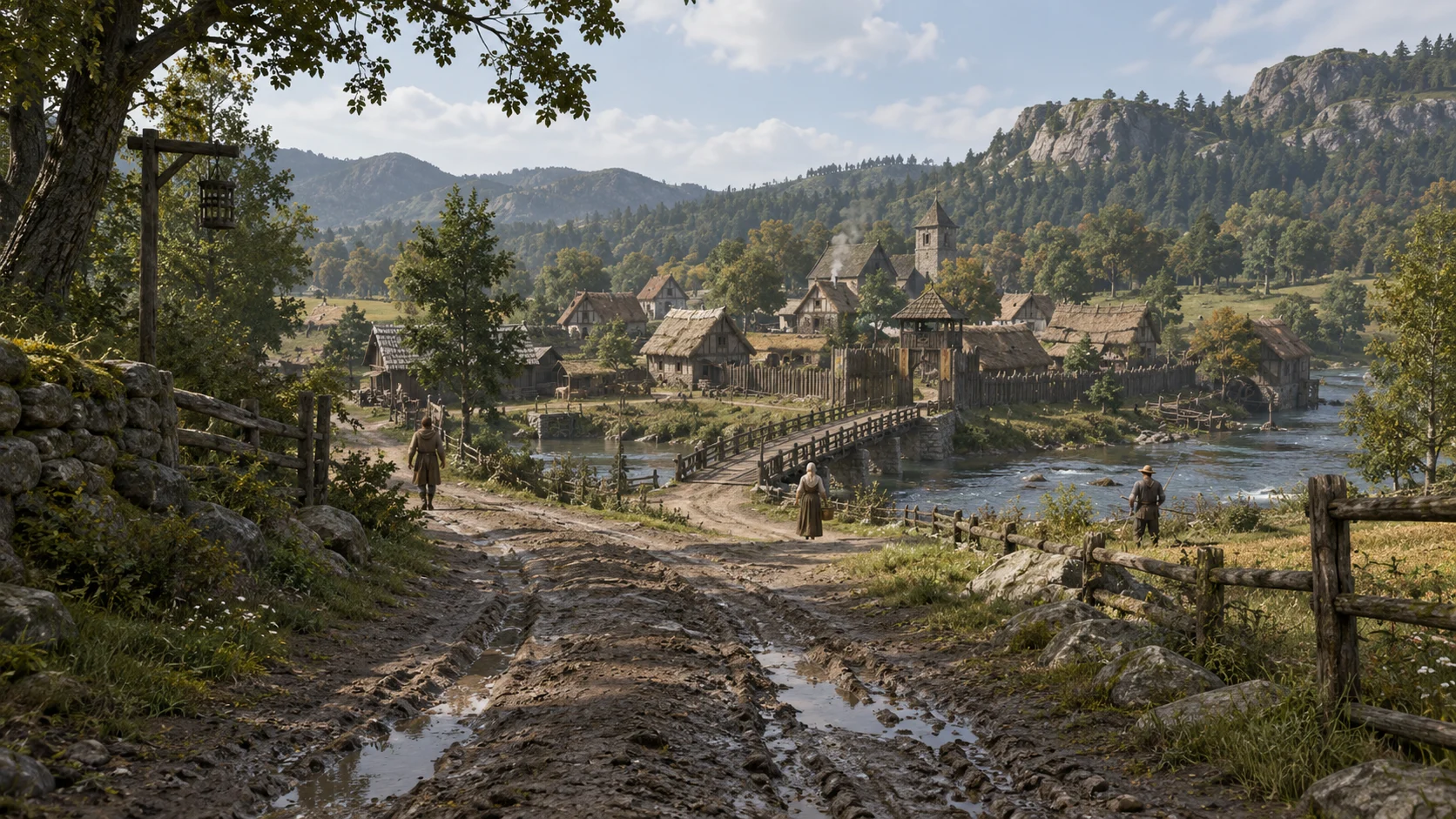
We're designing a first-person sandbox that connects personal combat, settlement management and regional politics. Play alone or with up to three friends in a world that keeps the consequences.
01 / The game
Your character is part of the world. You swing the sword, walk the roads and stand beside the people you recruit. Over time, a camp can become a settlement, and a few companions can become a fighting force.
We want the player to be present in the action. The aim is a grounded combat experience with responsive controls and a consistent first-person and third-person presentation.
Building a settlement, organising its people and forming a fighting force are connected parts of the game. We want the world around the player to develop with their decisions.
Trade, alliances and conflict should offer different ways to shape a region. The setting is medieval, with rare supernatural elements and a focus on choices that persist in the world.
02 / Technology
Unreal Engine 5 is the foundation. Our technical plan brings together realistic characters, a streamed environment, networked systems and a production workflow a small team can maintain.
The project is in pre-production. This is our intended stack; individual integrations will be confirmed through prototypes.
Engine & architecture
We plan to build the game in Unreal Engine 5, using its rendering, animation, world-building and multiplayer tools within one production environment. This keeps the work connected: a character can be assembled, animated, lit and tested in the same project.
C++ will handle the core systems and persistent data. Blueprint will support content assembly, interactions and quick iteration. Data assets will keep editable content separate from code, so changes do not require rewriting the underlying systems.
We want clear boundaries between world data, simulation, networking and presentation. That makes systems easier to test independently and reduces the risk of a visual or content change breaking an unrelated part of the project.
Unreal Engine 5.8 is the current evaluation baseline. The production build and plugins will be fixed after compatibility checks and representative scene tests. Upgrades will happen deliberately, with a working project to compare against. We do not want core production to depend on an experimental feature simply because it is new.
Environment rendering
Nanite is part of the planned environment pipeline for suitable high-detail geometry. Lumen is the lighting direction for dynamic global illumination and reflections. We will evaluate them together in the environments the game actually needs, rather than judging the result from a single showcase scene.
A consistent physically based material library will cover architecture, terrain, vegetation and props. The priority is a believable relationship between surfaces and lighting across the world.
Geometry, shadows, textures and lighting need quality tiers. The intended visual result must remain coherent at lower settings, with performance costs checked as the content develops.
Virtual Shadow Maps are a candidate for the shadow pipeline. Their use, along with Lumen settings and upscaling options, will be selected against measured GPU cost. The aim is a balanced real-time scene, not the highest possible setting in every menu.
Custom character pipeline
Our current reference is Unreal Engine and MetaHuman 5.8, checked against Epic's documentation in October 2026. The plan is to build a custom character pipeline around it: authored identities, project-specific materials and clothing, reusable animation and separate runtime quality profiles.
We want control over the character's appearance while retaining a common technical foundation. A source sculpt, fitted rig and production assembly will be kept as distinct assets so that improving one stage does not mean rebuilding everything.
We will begin with a custom human sculpt or appropriately licensed scan, refine the silhouette and proportions, and use the current From Custom Mesh workflow to conform the head and body to MetaHuman. The output adopts MetaHuman topology and rigging; the fitting result still needs an artist's review.
Source meshes will be cleaned before import. Loose clothing will be produced separately so its shape is not mistaken for the underlying body. Facial landmarks, hands and joints will receive a dedicated review after conforming.
The current Export tool supports geometry, DNA, materials and DCC packages. We plan to use that round trip for targeted adjustments in external content tools, then bring the result back into Creator. MetaHuman for Maya or Houdini can be evaluated where their supported tools solve a specific production need.
For Lostern, the useful improvement is traceability: each assembled character should point back to its approved source, fitting revision, wardrobe set and export profile. A new assembly should be reproducible rather than a collection of undocumented manual edits.
We will evaluate unbaked materials and texture overrides for custom skin detail, wear and a coherent art direction. The intention is to keep the character editable during look development, then use an appropriate assembly and material-baking path for the runtime asset.
Creator's custom lighting scenes offer a useful review stage. We plan to maintain lighting presets representing our environments and compare them with the actual level. These previews are templates, not a replacement for checking the finished character inside the game.
Our proposed wardrobe workflow uses modular clothing, accessories and hair with reviewed compatibility across a controlled set of body shapes. Each item will be checked for deformation, intersections, material consistency and distance-based detail.
Character variation will come from approved combinations and authored changes. The aim is to create a recognisable population without manually rebuilding every outfit or relying on unrestricted random combinations.
UE Optimized is the intended starting point for in-game assemblies. We will keep higher-detail authoring or presentation assets separate, and choose texture, hair and rig settings against the cost of the complete scene.
Our proposal is a small set of reviewed character profiles for close interaction, normal play and background use. The profiles will share source identities while changing presentation cost. Their quality and transitions must be checked in packaged builds.
The MetaHuman Creator Python API and Editor Utility Blueprints provide a route to scripted creation, editing, conforming, assembly and export. We plan to build small tools for applying approved profiles, naming assets consistently, collecting dependencies and producing review batches.
A character recipe would record the source asset, approved appearance choices and assembly settings. Automation would then rebuild the candidate and prepare it for review. The artistic decision remains explicit; the repetitive editor work becomes easier to reproduce.
Development research
These are proposed development experiments. Each needs to demonstrate a useful result in this project before it becomes part of the production pipeline.
MetaHuman 5.8 introduces experimental markerless body or combined face-and-body capture from one camera. We plan to test the Windows workflow for reference performances and selected authored animation, with cleanup and retargeting as part of the process. It could lower the barrier to producing original performances without making raw capture a final asset.
The experimental MetaHuman Crowds workflow supports modular collections and transitions between detailed Actors and lighter representations. We want to test whether it can reduce the visual cost of background populations while our persistent identity data stays separate. Rendering a crowd does not establish that the same number of fully simulated characters will work.
UE 5.8's Unreal MCP integration and MetaHumanGenerator toolset are candidates for assisted character setup. Our proposed use is narrow: create draft assets, apply approved appearance parameters and prepare candidates for review. Python-based assembly tools would handle the repeatable processing behind them.
Source-controlled changes, explicit operation boundaries and before-and-after review are part of the proposed workflow. The goal is faster iteration on our own assets, not unattended changes to the production project.
Unreal Animation Framework support for MetaHuman assembly is experimental and will be compared with the Animation Blueprint baseline. OpenRigLogic and the MetaHuman Devkit are also relevant to future custom tooling, but building a separate character platform is not a requirement for this game.
We will retain the simpler production path until an experiment shows a clear gain in asset quality, iteration time or runtime cost. This lets the project use current technology without tying its schedule to every new feature.
Animation pipeline
The intended animation pipeline combines Animation Blueprints, Control Rig and IK Rig / IK Retargeter. Together, these give us a way to organise runtime animation, make rig adjustments in the engine and adapt animation between characters with different proportions.
Motion Matching is under evaluation for locomotion. Its database-driven pose selection could help produce more natural movement transitions, but it also needs a suitable animation library. We will compare it with a simpler animation setup before making it a production dependency.
The first-person and third-person presentation will be developed around compatible character data. Animation assets, camera work and interaction alignment need to be considered together. Retargeting reduces repeated work; it does not remove the need to review each result in context.
Sequencer will support authored presentation where it is useful. Facial animation and capture workflows can be added as the content justifies them, without making a full performance-capture pipeline a prerequisite for the first prototype.
World building
World Partition is the planned starting point for environment streaming. We will evaluate HLOD and distance-based detail alongside it, with the goal of keeping large views readable while limiting the amount of detailed content active at once.
The environment pipeline will use modular architecture, reusable materials and organised asset sets. Settlements and important locations will be authored intentionally. Procedural Content Generation tools are a candidate for repeatable environment dressing, where they can save production time without deciding the layout for us.
Visual streaming and persistent world data will remain separate concerns. A location can leave memory while its identity and state remain in the save. This separation is especially important for co-op, where players may be in different areas.
Custom work and licensed assets will follow the same scale, material and naming conventions. Third-party content will be reviewed for visual fit, technical cost and usage rights before it becomes part of the production library.
Behaviour & world data
StateTree and Smart Objects are candidates for structured character behaviour and usable locations in the environment. We want behaviour to be visible in debugging tools, so it is possible to understand what a character is doing and what it is waiting for.
Persistent entities will use stable identifiers and structured records. The visible characters and objects can then be created or unloaded without becoming the only source of truth for the world. Save-format versioning and recovery will be designed alongside the systems that produce the data.
We will begin with an architecture that is straightforward to inspect. Larger frameworks such as MassEntity will be considered if profiling shows a clear benefit. The choice will follow an identified bottleneck, rather than a target technology list.
Multiplayer foundation
The project targets solo play and two-to-four-player co-op. Our starting point is Unreal's networking framework with a host-authoritative model. Shared state will be validated by the host, while the client handles the presentation needed for a responsive experience.
The Character Movement Component provides the starting point for networked movement. Replication, relevancy and update frequency will be evaluated for the game's own actors and data. Networking will be part of early development, rather than an addition after a single-player game is complete.
Session joining, reconnection and world persistence will be tested together. The first scope uses a host-owned save and ends when the host leaves. Dedicated hosting and host migration remain later decisions, dependent on the actual product requirements.
The useful test case is a shared world under normal latency with players in different locations. We will profile that workload alongside rendering and simulation, because the host has to run all three.
Profiling & quality
Unreal Insights will be central to performance work: CPU timing, memory and network traces help identify where the cost is coming from. GPU profiling and the engine's diagnostic views will support rendering decisions.
We will keep repeatable test scenes for environments, characters and multiplayer. Results need a recorded hardware configuration, engine version and quality preset. Editor performance alone will not stand in for testing a packaged build.
Frame pacing, memory growth, loading interruptions and network behaviour will be reviewed together. Average FPS is only one part of whether the game feels consistent.
Automated checks will cover core data and loading paths where they are useful. Playtests will cover the experience that cannot be reduced to a passing technical check.
Public hardware requirements and performance claims will come from working builds. At this stage, we are defining the measurement process and technical priorities.
Production workflow
The source and content workflow will use version control, isolated changes and regular playable builds. Git with large-file storage is the initial direction for code and binary assets. File organisation and asset ownership need to stay clear as outside contributors join specific pieces of work.
We will start with a compact environment that exercises the engine, character and multiplayer pipelines together. Once that foundation is stable, content can expand through repeatable imports, shared materials and reusable systems.
External support is planned for specialised work where it makes sense, particularly character or animation work, technical art and audio. Deliverables need a defined format and an in-engine acceptance check, so a finished asset can actually be integrated.
Engine version, core plugins, rendering and character pipeline.
Bring world data, animation and co-op into one environment.
Use measured performance, production time and playtest feedback.
The project has no announced release date. The next commitment is a working foundation and a realistic understanding of the cost of making more content.
AI-assisted development
We plan to use Claude, Codex and other AI tools for programming assistance, debugging, documentation, test design and early content exploration. They can help a small team work through implementation alternatives and repetitive tasks.
Changes still need review and in-engine validation. The developer owns the architecture, checks the integration and decides whether the result works. Generated code is a starting point for development, not proof that a feature is ready.
Visual references can help establish direction before production art is made; they will be labelled as references. Final game assets need their own production and review process.
The current use of AI is in development. Live language-model-driven NPC dialogue is outside the planned runtime scope, and ordinary play is not intended to depend on an external AI service.
03 / The studio
Lostern Games is an independent venture led by Eren Hukum in Türkiye. Right now, development is led by one person, with AI tools supporting programming, debugging, test design and content drafts. Limited outside help is planned where specialist work is needed.
The project is in concept and pre-production. We are establishing the Unreal Engine workflow and defining a manageable first playable version before expanding production.
We will share progress as the project moves from design into working builds. There is no public demo or release date yet.
Define the systems, their limits and the first region.
Validate the engine, character and co-op foundations.
Bring the art and engineering pipelines into one playable slice.
04 / Get in touch
Questions about the project, collaboration or development? Write to Lost.